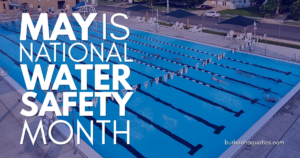
May is National Water Safety Month: a time to reflect on what it means to truly protect our communities in and around water.
Drowning is the leading cause of unintentional injury death for children ages 1 to 4, and the second leading cause for children ages 5 to 14. It is largely preventable. And yet, in cities and towns across the country, public swimming pools have been closing at an alarming rate, leaving entire generations of children without the foundational skills that could save their lives.
This month, we’re making the case that a public pool is not a luxury. It is a civic investment, in lives saved, in health protected, in communities strengthened. And for the leaders, advocates, and neighbors who care about the future of their communities, now is the time to act.
The Crisis No One Talks About
Across America, roughly 309,000 public swimming pools existed in the mid-20th century, many of them municipally operated. Today, that number has declined sharply, and the pools that remain are disproportionately located in wealthier communities. The result is a water safety gap that falls hardest on the children who can least afford it.
A public aquatic facility changes that equation. It opens the door. It makes the lesson possible. It saves lives.
What a Pool Actually Does for a Community
When we design and engineer aquatic facilities for municipalities, our clients often come to us focused on a single purpose — a lap pool, a spray park, a therapeutic pool. But what they end up with is something far more layered. A well-designed public pool serves a community across generations, abilities, and seasons. Here’s what it truly delivers:
- 88% of drowning deaths are preventable with swim education and supervision
- 3-7% return on investment municipalities see from aquatic facilities in health cost saving
- 6 years old is the age at which swim lessons begin to dramatically reduce drowning rist
- 54% of Americans cannot swim or lack the basic water safety skills to save themselves, per the Red Cross
Why Public Pools Matter: The Four Pillars
- Life-Saving Swim Skills: Swim competency is a public safety issue. Children who receive formal swim instruction are 88% less likely to drown. A public pool is the single most scalable way to deliver that protection to every child in a community, regardless of household income.
- Accessible to Everyone: Modern aquatic facility design embraces universal access; zero-depth entries, lift systems, sensory accommodations, and therapeutic programming. A public pool is one of the few community spaces where someone with a mobility challenge, aging joints, or a developmental difference can exercise with genuine freedom.
- Health Across Every Age: Swimming is among the most complete forms of physical activity. It’s the exercise a 7-year-old, a new mother, a 70-year-old with arthritis, and a person recovering from surgery can all do safely. With the right programming public pools reduce chronic disease burden and can relieve downstream pressure on healthcare systems.
- A Lasting Community Asset: Aquatic facilities anchor neighborhoods. They generate jobs, drive youth programs, host competitive events, and become sources of genuine civic pride. The communities with thriving public pools see measurable increases in property values, volunteer engagement, and cross-demographic connection.
The Business Case for Municipal Leaders
We understand that every capital project competes for limited budget. Pools have a reputation, sometimes fairly earned, for high operating costs. But that framing tells only part of the story.
When properly designed, programmed, and managed, public aquatic facilities generate significant earned revenue through fees, rentals, swim school programs, and aquatic therapy contracts. Beyond direct revenue, the public health ROI is measurable: lower rates of obesity, cardiovascular disease, and injury-related emergency care among communities with strong aquatic access.
There are also funding pathways that many municipalities don’t fully explore. Federal CDBG grants, LWCF funding, state recreational bonds, public-private partnerships, foundation grants, and community naming rights campaigns have collectively funded millions of dollars in aquatic infrastructure across the country. The capital hurdle is real, but it is not insurmountable.
For the Community Builders Reading This
Maybe you’re not a city council member. Maybe you’re a parent who grew up at a neighborhood pool that no longer exists. Maybe you’re a coach who sees kids arrive at the water terrified because they’ve never been taught. Maybe you run a local foundation or lead a neighborhood association and you want to do something that genuinely changes lives.
Advocacy matters. Fundraising matters. Showing up to council meetings matters. The communities that have successfully built or restored public pools almost always have a story of organized, persistent neighbors who refused to let the project die, who raised seed money, secured grants, built coalitions, and showed decision-makers that the demand was real and broad.
Your role in this is not peripheral. It is essential.
What Great Aquatic Design Looks Like
A modern public aquatic facility is not the concrete box of 1970. Today’s best designs weave together safety-first engineering, therapeutic programming zones, zero-depth family areas, competitive lanes, shaded gathering spaces, and sustainable systems that reduce operating costs over the long term.
Good design accounts for the full community: the competitive swimmer who trains at 5 a.m., the toddler who needs a gentle splash area, the senior doing water aerobics, the teenager learning to lifeguard, the family that just wants a summer afternoon together. All of them belong in the water. Great facilities make room for all of them.
As aquatic engineers and architects, we believe our deepest responsibility is not to build beautiful buildings, though we care deeply about that. It’s to build infrastructure that makes communities safer, healthier, and more equitable. Pools do all three.
This May, Make It Personal
National Water Safety Month is a reminder, not just of the danger of water, but of the promise of it. Water heals. It connects. It teaches children that they are capable of things that once frightened them. It gives aging bodies a place to move. It brings neighborhoods together on hot summer days.
The communities that invest in public aquatic infrastructure are making a bet on all of that. They’re saying: our children will know how to swim. Our elderly neighbors will have a place to stay healthy. Our families will have somewhere to go. Our community will be safer, stronger, and more connected because of this place we built together.
That’s a bet worth making.
If your community is ready to start that conversation, whether you’re a mayor with a site in mind, a council member with questions about costs, a donor looking for a transformational gift, or a neighbor who just wants their kids to learn to swim, we would be honored to be part of it.
Reach out. Let’s build something that saves lives.
Recent Comments